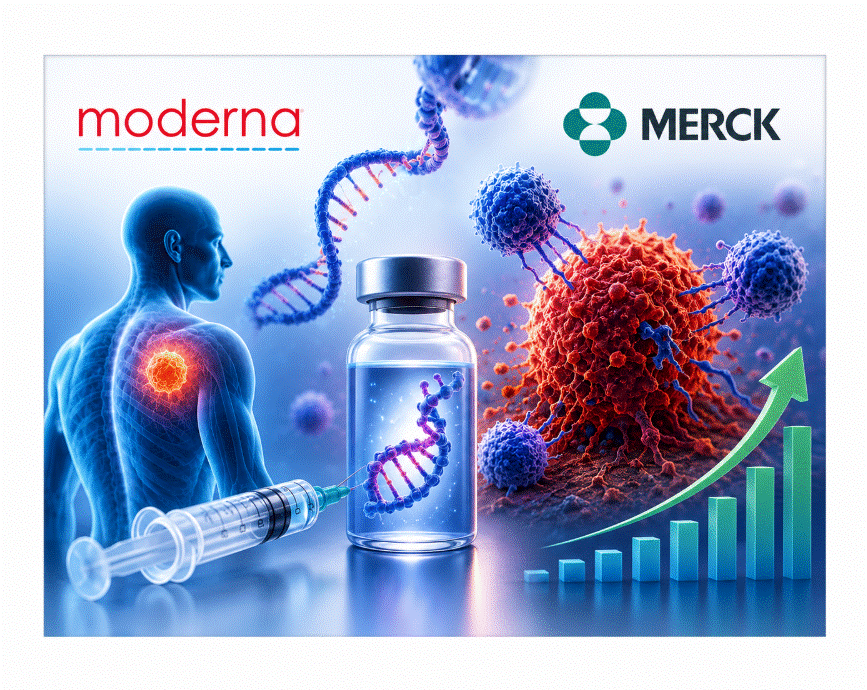

What the Phase 3 intismeran autogene + Keytruda results mean for the next wave of personalized cancer vaccines — and why melanoma was always the easiest place to prove the concept
For years, personalized cancer vaccines have been one of biopharma’s most-promised, least-proven ideas — a technology that made intuitive sense but lacked a definitive Phase 3 result to anchor it. That changed this week. Merck and Moderna announced that their individualized mRNA vaccine, intismeran autogene, combined with Keytruda, succeeded in a large Phase 3 trial of more than 1,000 melanoma patients, reducing cancer recurrence and spread after surgical removal of high-risk tumors. Oncologists are already calling it a genuine inflection point for the field — not because melanoma alone is a large commercial opportunity, but because of what a positive Phase 3 signal here implies for the much bigger tumor types now queued up behind it.
What Makes This Different From Standard Immunotherapy
Chemotherapy kills cancer cells indiscriminately, damaging healthy tissue along the way. Standard immunotherapy, like Keytruda alone, works by releasing the brakes on a patient’s immune system broadly. A personalized cancer vaccine does something more specific: it’s manufactured individually for each patient, designed to train their immune system to recognize the exact mutations present only in their own tumor. In principle, that specificity should mean a more targeted, more durable anti-cancer immune response than either chemotherapy or immunotherapy can achieve alone — the open question has always been whether that theoretical advantage would show up in a large, randomized trial.
The Regimen and the Safety Signal
Patients in the trial received up to nine doses of Keytruda every six weeks alongside up to nine doses of the customized mRNA vaccine, in patients who had already had their melanoma tumors surgically removed but remained at meaningful risk of recurrence. Critically, adding the vaccine to Keytruda didn’t introduce new safety concerns beyond Keytruda’s already-known side-effect profile (fatigue, diarrhea, rash, and joint or muscle inflammation being the most common). Reported vaccine-specific reactions were described as comparable to a typical flu or COVID-19 shot — a meaningful detail for a therapy intended to be layered onto an already-demanding adjuvant treatment course.
Earlier five-year follow-up data from the companies’ prior mid-stage trial, presented earlier this year, had already shown the combination cut recurrence risk roughly in half and reduced the risk of the cancer spreading to new sites by well over half compared to Keytruda alone — with no increase in serious side effects. This new Phase 3 result is the large-scale confirmation of that earlier signal.
Why Melanoma Was the Logical First Target
Melanoma wasn’t chosen arbitrarily. It’s a cancer type that tends to carry an unusually high mutational burden, which gives a personalized vaccine more distinct targets to work with — in effect, more “flags” for the immune system to learn to recognize. That’s precisely why oncologists are treating this result as a signal that extends beyond melanoma itself: several other cancer types share that high-mutation-burden profile, and a validated mechanism in the hardest-to-argue-against setting strengthens the case for the mechanism working elsewhere too.
That “elsewhere” is already well underway. Merck and Moderna have large trials running in resected non-small cell lung cancer, mid-stage studies in bladder and kidney cancer, and earlier-stage work beginning in pancreatic and stomach cancer, with multiple additional readouts expected over the next one to two years.
The Competitive Picture: This Is Not a One-Company Race
Roche and BioNTech are pursuing a parallel approach with their own individualized mRNA cancer vaccine, autogene cevumeran — built on mRNA technology with roots in the platform behind the Pfizer-BioNTech COVID-19 vaccine — currently in mid-stage trials for colon and pancreatic cancer patients following surgery. Colon cancer results are expected in 2027, with pancreatic cancer data following in 2031. The two programs are targeting different tumor types for now, but both are testing the same underlying thesis: that a vaccine trained on a patient’s own tumor mutations, layered onto standard immunotherapy, can meaningfully improve on immunotherapy alone.
Why This Could Shift Clinical Decision-Making, Not Just Pipeline Valuations
One detail from physicians close to the trial is worth flagging for anyone modeling the commercial opportunity here: oncologists have historically had to weigh Keytruda’s cumulative side-effect burden against a fairly modest reduction in recurrence risk for patients whose baseline risk was already relatively low — for instance, around a 20% chance of recurrence. A vaccine that meaningfully improves on Keytruda’s benefit without adding new safety concerns could shift that calculus for a much larger share of post-surgical patients than the highest-risk subgroup alone, expanding the addressable population beyond where adjuvant immunotherapy has traditionally been used most aggressively.
What to Watch
For the mRNA oncology platform broadly: This result functions as a proof-of-concept the entire personalized-vaccine category has lacked. Expect increased investment and faster trial enrollment across the sector as a result, not just at Merck/Moderna and Roche/BioNTech.
For manufacturing and commercial complexity: Personalized vaccines are, by definition, manufactured per-patient — a fundamentally different commercial and logistical model than an off-the-shelf biologic. How that manufacturing scales beyond a melanoma-sized population, into larger tumor types like lung or colorectal cancer, will be a critical test of whether this approach can work commercially at scale, not just clinically in a trial.
For the competitive landscape in immuno-oncology combinations: A validated vaccine-plus-checkpoint-inhibitor combination raises the bar for any single-agent immunotherapy asset in the adjuvant setting, and gives Merck a distinct life-cycle extension strategy for Keytruda as it approaches patent expiry later this decade.
BioNextAI Market Insights View
The headline number here is a melanoma trial result, but the more important story is what it validates: that mRNA-based personalized cancer vaccines, layered onto existing immunotherapy, can move a hard clinical endpoint — recurrence and spread — without a new safety trade-off. Melanoma was always the easiest place to prove that, given its high mutational burden. The real test now shifts to the tumor types already in the pipeline behind it — lung, bladder, kidney, pancreatic, and colorectal cancers — where both Merck/Moderna and Roche/BioNTech have trials reading out over the next one to five years. If even a subset of those trials replicate what melanoma just showed, this stops being a single-product story and becomes a platform one.
About BioNextAI Market Insights Bionext AI Market Insights delivers data-driven intelligence on biopharma commercial strategy, market access, and competitive dynamics for investors, strategy teams, and industry stakeholders.
This analysis is based on public reporting current as of publication, including Reuters’ coverage of the Merck/Moderna trial announcement (August 19, 2026). It does not constitute investment advice. Full trial results have not yet been published in full; figures and characterizations are subject to revision upon formal peer-reviewed publication.


 By
By