
Analysis of the FDA’s TEMPO pilot, its first AI-enabled participant, and what it signals for how algorithmic health tools get evaluated and paid for in the U.S.
GLOBAL BIOPHARMA & AI HEALTH DESK — Buried inside a fairly technical-sounding FDA pilot announcement is a signal worth pulling out on its own: for the first time, a U.S. regulator and the Medicare payment system are building a joint pathway specifically designed to let an AI-driven monitoring tool earn reimbursement based on the outcomes its algorithms help produce — not on the device itself. At Bionext AI Market Insights, we think that distinction is the real story in the FDA’s July 22, 2026 announcement naming Dexcom the first participant in its TEMPO pilot.
What Was Announced, and Where the AI Actually Sits
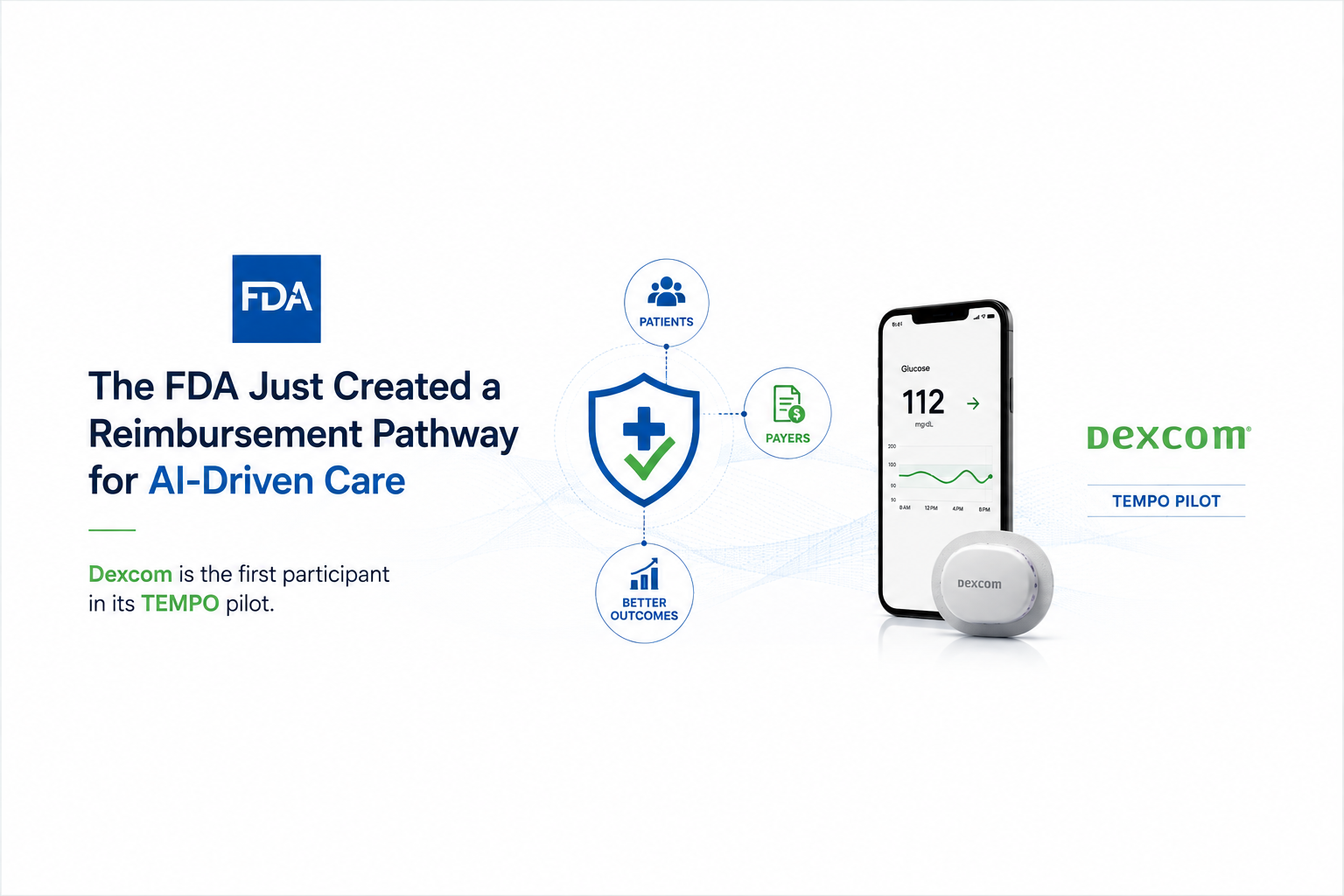
The FDA selected Dexcom’s Glucose Health Program as the first participant in TEMPO (Technology-Enabled Meaningful Patient Outcomes), a pilot built to work alongside CMS’s new ACCESS (Advancing Chronic Care with Effective, Scalable Solutions) Model, whose first patient cohort began the same month. The program is explicitly described as delivering “real-time data and AI insights for informed decision-making and behavioral modifications” — positioning the AI layer, not just the underlying glucose sensor, as the clinically active component the FDA and CMS intend to evaluate. Its intended uses span two areas: aiding in the screening of prediabetes and type 2 diabetes through continuous digital health metrics, and supporting improved glycemic control and lower HbA1c through AI-generated, tailored guidance to patients and their care teams.
That framing matters. Continuous glucose monitoring hardware has existed and been reimbursed for years. What’s new here isn’t the sensor — it’s the regulatory and payment system attempting, for the first time in this kind of structured pilot, to evaluate and pay for the algorithmic interpretation layer sitting on top of the raw sensor data.
Why AI Tools Need a Different Evidence Pathway Than Traditional Devices
Most FDA device clearances evaluate a fixed, well-defined product against a fixed set of claims. AI-driven clinical tools — particularly ones that generate “insights” and behavioral recommendations rather than a single measurable output — don’t fit that model cleanly, for a reason regulators have wrestled with for years: an algorithm’s real-world performance depends heavily on the population it’s deployed in, how clinicians and patients actually act on its outputs, and how its recommendations perform when tested against outcomes over time, not just against a validation dataset at clearance.
TEMPO is a direct response to that problem. Rather than asking whether an AI tool met a pre-specified accuracy benchmark once, it requires manufacturers to continuously collect, monitor, and report real-world data on how their AI-enabled tools perform once deployed — explicitly built to test whether an algorithm’s guidance actually improves the outcome it claims to influence (in Dexcom’s case, glycemic control and HbA1c) when used at scale in real patients. That’s a fundamentally different evidentiary bar than a traditional one-time device clearance, and it’s a bar most AI health tools on the market today have not been asked to clear.
The Payment Model Is the Part That Should Get AI Companies’ Attention
The more consequential piece, in our view, is what happens to that evidence once collected. CMS’s ACCESS Model is structured to pay participating organizations for measurable improvements in patient outcomes rather than for discrete billed services — and TEMPO exists specifically to generate the real-world evidence that lets CMS make that outcomes determination for AI-enabled tools.
Put simply: this is a nascent but real attempt to build a Medicare payment pathway where an AI algorithm’s reimbursement is tied to the outcome data it can prove it produces, evaluated continuously rather than at a single clearance point in time. For an AI health tech sector that has struggled for years with the more basic question of “how does an algorithmic tool actually get paid for by a U.S. payer,” this is one of the more concrete structural answers to emerge to date — even if, at pilot scale, it currently applies to a small number of participants across four clinical use areas.
Reading Dexcom’s Selection as a Signal for AI-Enabled Health Tech Broadly
Dexcom’s selection — an already-commercialized platform with years of real-world sensor deployment now being extended with an AI insights layer — suggests the FDA and CMS Innovation Center are prioritizing pilot participants who can generate real-world evidence quickly, because they already have the data infrastructure and patient base in place. That’s a meaningful signal for the wider AI-in-healthcare landscape: companies whose algorithms are bolted onto platforms with mature, at-scale real-world data pipelines look better positioned to compete for one of the roughly 40 available TEMPO slots than earlier-stage AI tools without that deployment history, regardless of how sophisticated the underlying model is.
It also suggests a broader evaluative principle likely to extend beyond this pilot: as more AI-driven diagnostic, monitoring, and clinical-decision tools reach the market, “does this algorithm have a credible plan to generate continuous real-world outcomes evidence” may increasingly matter as much to regulators and payers as the algorithm’s reported accuracy at launch.
What to Watch
For AI health tech developers: Real-world evidence generation infrastructure — not just model performance — is emerging as a genuine competitive differentiator for regulatory and reimbursement purposes, not just a nice-to-have for post-market surveillance.
For pharma companies building AI-enabled companion tools: A Medicare pathway that pays for AI-driven outcome improvement, rather than the device or drug alone, strengthens the commercial case for bundling algorithmic monitoring and adherence tools alongside chronic-disease therapeutics — an area adjacent to the diabetes and metabolic-disease pricing dynamics we’ve tracked elsewhere in GLP-1 and IRA negotiation coverage.
For the regulatory landscape overall: TEMPO is a pilot, not a permanent framework, but it’s a concrete test case for how the FDA might eventually evaluate continuously-learning or continuously-updated AI systems more broadly — a question regulators have signaled they intend to address well beyond this specific chronic-disease pilot.
BioNextAI Market Insights View
The headline here isn’t “Dexcom joins a pilot program” — it’s that U.S. regulators are now testing, in a live payment model, whether an AI algorithm’s clinical value can be measured and reimbursed based on the real-world outcomes it demonstrably produces, evaluated continuously rather than at a single approval snapshot. That’s a meaningfully different bar than most AI health tools have had to clear to date, and if the ACCESS Model scales beyond its pilot cohort, the companies best positioned to benefit will be the ones already treating real-world evidence generation as core infrastructure — not the ones with the most sophisticated algorithm on paper.
About Bionext AI Market Insights Bionext AI Market Insights delivers data-driven intelligence on AI-enabled healthcare, biopharma commercial strategy, and market access dynamics for investors, strategy teams, and industry stakeholders.
This analysis is based on publicly available government disclosures current as of publication. It does not constitute investment advice. Details of the TEMPO pilot and ACCESS Model are evolving; readers should consult FDA and CMS sources directly for current program status.

 By
By