
A look at GSK’s new Cambridge research centre, its cost-cutting programme, and what a 75% profit drop tells us about the economics of pipeline-led growth
LONDON / GLOBAL BIOPHARMA DESK — GSK is doubling down on research and development at exactly the moment its bottom line looks weakest — a sequencing that says as much about the company’s growth strategy as any single announcement could.
The Headline Numbers
GSK’s Q2 2026 results, released this week, show a company growing revenue while absorbing a sharp earnings hit. Total revenue rose 5% at constant currencies to £8.4 billion, ahead of expectations, with the company’s Specialty Medicines division — spanning respiratory, immunology and inflammation, oncology and HIV — up a stronger 14% to £3.8 billion, with double-digit growth across all four therapeutic areas.
Operating profit told a very different story: it fell 75% to £481 million, a decline the company attributes largely to a roughly £1.3 billion impairment charge tied to the discontinuation of its cough-drug candidate camlipixant. It’s a reminder that pipeline setbacks in biopharma aren’t abstract — they show up directly on the P&L, often in the same quarter as otherwise strong commercial performance.
The Strategy: Spend More on R&D to Spend Less Later
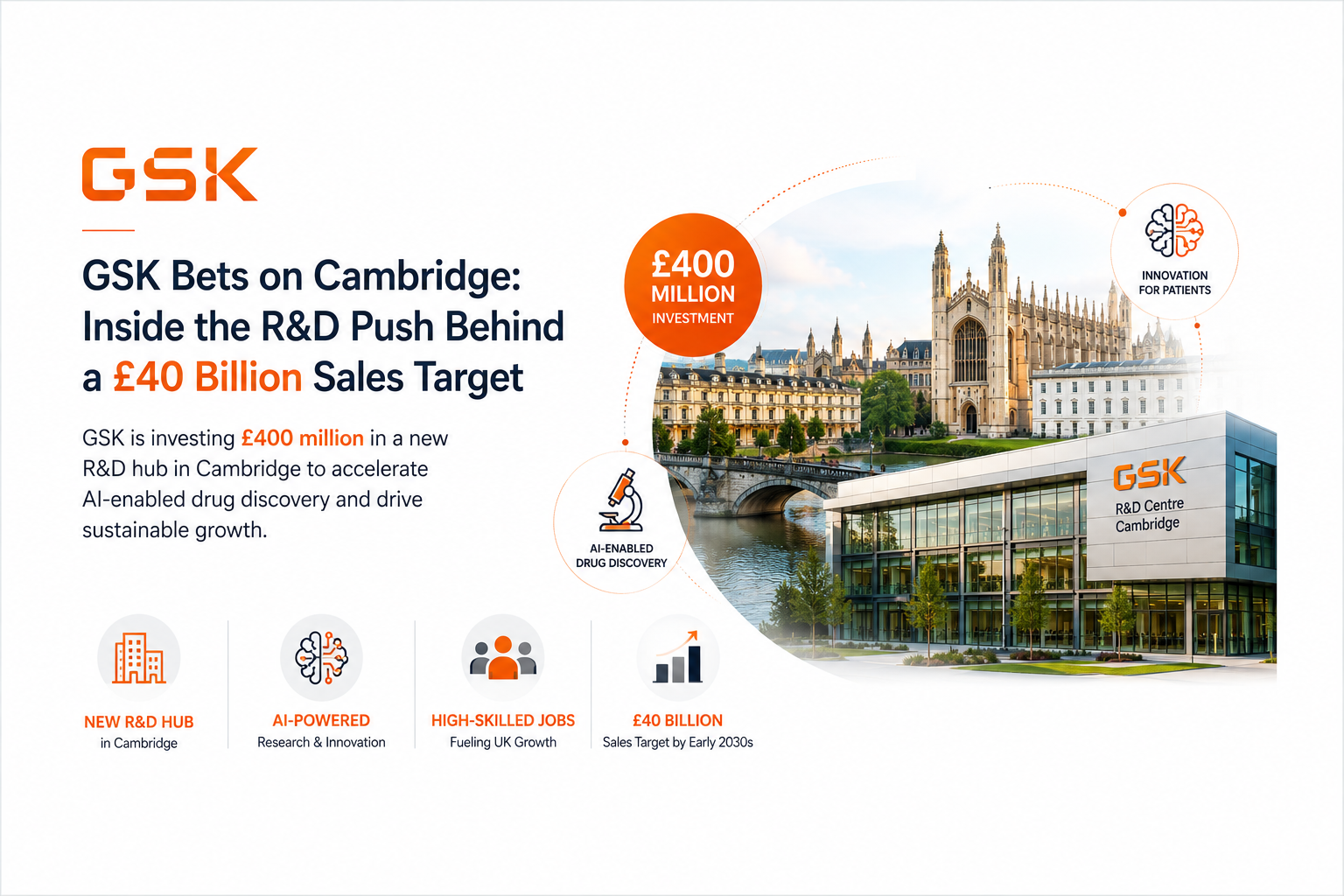
Rather than pulling back after the camlipixant write-off, GSK is leaning further into research. The company has launched what it calls its “Accelerate Growth” programme, centred on a new flagship R&D facility at Cambridge’s Biomedical Campus and a commitment to double late-stage clinical trial starts in 2026. The explicit goal: build a pipeline robust enough to hit £40 billion in sales by 2031.
Alongside the R&D expansion, GSK announced a parallel cost-savings initiative targeting £1.9 billion in annual savings by 2029 — savings the company says will help fund the very pipeline investment it’s now accelerating. Management has acknowledged that R&D spending will outpace sales growth in the near term as a direct consequence of this strategy.
Industry analysts see the camlipixant write-off less as a strategic failure and more as an illustration of the sector’s underlying risk profile — a reminder that experimental medicines fail even at well-resourced companies, and that R&D-heavy growth strategies inherently carry lumpy, hard-to-predict earnings.
Why the UK Location Matters
The Cambridge investment also lands squarely inside a broader UK policy push. The government has framed the announcement as validation of its Life Sciences Sector Plan and wider industrial strategy, pointing to more than £3 billion in new public-private life sciences investment across the UK over the past 12 months. For a sector increasingly shaped by where governments choose to compete for pharmaceutical manufacturing and R&D capacity — a dynamic we’ve tracked closely in the context of U.S. tariff and reference-pricing policy — GSK’s decision to anchor new capacity in the UK is a data point worth watching alongside similar moves elsewhere.
BioNextAI Market Insights View
GSK’s Q2 print is really two stories layered on top of each other: a commercial business performing well, particularly in specialty medicines, and a research engine absorbing the kind of write-off that comes with betting on unproven science. The company’s response — accelerating R&D spend and trial starts rather than retrenching — is a high-conviction bet that a deeper, faster-moving pipeline is the more durable path to its 2031 revenue target than near-term margin protection. Whether that bet pays off will depend less on this quarter’s numbers than on whether GSK can convert a larger, faster pipeline into approved medicines at a rate that outpaces the write-offs — the same execution risk that produced this quarter’s £1.3 billion charge in the first place.
About Bionext AI Market Insights Bionext AI Market Insights delivers data-driven intelligence on biopharma commercial strategy, market access, and competitive dynamics for investors, strategy teams, and industry stakeholders.
This analysis is based on publicly available company disclosures and third-party reporting current as of publication. It does not constitute investment advice. Figures cited reflect GSK’s Q2 2026 half-year results and related company and government announcements.


 By
By