
Analysis of Prosper Medical’s seed round, its AI-powered care model, and what it signals about the next phase of AI in primary care
GLOBAL AI HEALTH DESK — Concierge medicine has always solved the same problem the same way: charge enough that a physician can afford to know a small panel of patients well. Prosper Medical, a San Francisco-based primary care startup, just raised $16 million on the bet that AI can break that trade-off — delivering the continuity of concierge care through in-network insurance, at a flat $69-a-month membership, rather than through cash-pay exclusivity. At Bionext AI Market Insights, we see this as a useful test case for a broader question: can AI actually expand who gets high-touch care, or does it mostly just make existing high-touch care cheaper to deliver to the same patients who already had access?
What Was Announced
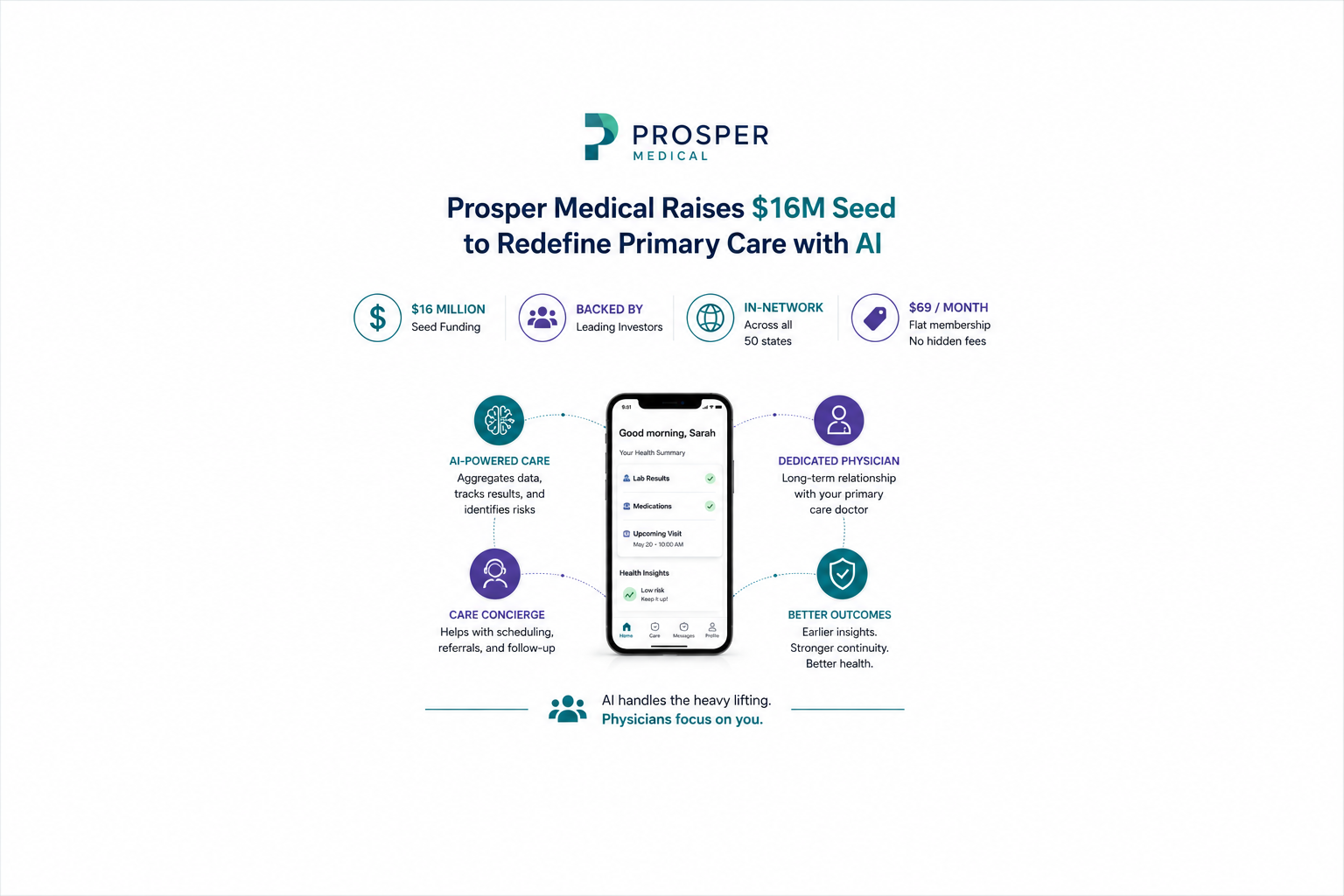
Prosper Medical secured $16 million in seed financing led by FUSE, with participation from Aurum Partners, Better.vc, Cal Innovation Fund, Fluent, Latitude Capital, Knoll Ventures, and WTI. The company intends to use the capital to expand its physician network, continue building out its AI care platform, and grow into new markets.
Prosper was founded by Ryan McQuaid (CEO) and Dr. James Wantuck (CMO), who previously built and sold PlushCare — one of the first direct-to-consumer telehealth platforms — to Accolade for $450 million. That prior exit matters for how to read this round: the founders are explicitly positioning Prosper as a correction to what they see as telehealth’s unfinished business. Telemedicine solved convenience; it didn’t solve the loss of a continuous, trusted physician relationship that fee-for-service primary care has struggled to sustain.
Where the AI Actually Does the Work
Prosper’s model pairs a dedicated primary care physician with what the company describes as an AI-powered care layer — software that sits between visits, aggregating patient health data, tracking lab and test results, coordinating specialist referrals, and identifying early risk signals, while a separate Care Concierge team helps patients navigate scheduling and follow-up care. The stated design intent is for AI to function as an operational multiplier for the physician relationship, not a substitute for it: automating the coordination and administrative load that typically consumes physician time, so doctors can spend more of their limited hours on the parts of care that require a human relationship.
That’s a meaningfully different AI value proposition than the “AI replaces the visit” framing common in earlier telehealth and symptom-checker products. The clinical judgment stays with a physician; the AI’s job is continuity — making sure nothing said in one appointment, one lab result, or one referral gets lost before the next one.
Why the Insurance-Network Model Is the More Interesting Bet Than the AI Itself
Most concierge medicine platforms remain cash-pay, which structurally caps their addressable market at patients wealthy enough to absorb a premium membership fee on top of existing insurance costs. Prosper is instead in-network with major insurance plans and operating across all 50 states — a decision that trades away some of the premium pricing concierge models rely on in exchange for a much larger potential patient base.
That trade-off is only economically viable if the AI layer genuinely lowers the cost of delivering continuity-of-care at scale — more patients per physician, without the quality erosion that usually comes with a larger panel. In effect, Prosper’s $69/month price point is a direct wager that AI-driven care coordination can substitute for some of the premium that concierge medicine has historically charged for physician time and attention. If that wager doesn’t hold — if AI coordination tools don’t meaningfully expand physician capacity without degrading the relationship-driven experience patients are paying for — the model reverts to a familiar tension in value-based primary care: promising more attention per patient while trying to serve more patients per physician.
How This Fits the Broader AI-in-Healthcare Reimbursement Picture
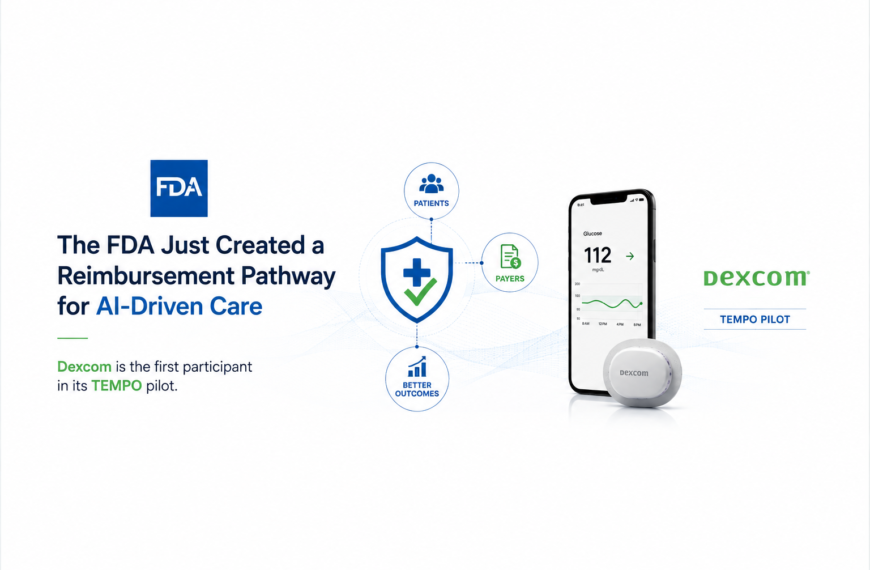
This raise lands alongside a broader shift we’ve been tracking toward reimbursement models that pay for demonstrated outcomes rather than discrete services — including the FDA’s new TEMPO pilot, which is testing a Medicare payment pathway explicitly tied to real-world evidence generated by AI-enabled tools. Prosper operates in a different reimbursement lane (traditional insurance-network primary care rather than a CMS innovation model), but the underlying logic is similar: AI’s commercial case in healthcare increasingly rests on its ability to prove it improves an outcome or expands capacity at the same quality level, not simply on being AI-branded software layered onto an existing service.
For venture investors and health systems watching this space, Prosper’s model is also a data point on where AI-native primary care companies are choosing to compete: not on replacing physicians, and not on pure cash-pay convenience, but on using AI to make an insurance-covered, physician-led relationship economically sustainable at a broader price point than concierge medicine has historically supported.
What to Watch
For AI health tech investors: Seed-stage capital is increasingly backing AI-as-infrastructure models — where the algorithm’s job is coordination and continuity rather than diagnosis or treatment recommendation — a lower-regulatory-risk entry point than clinical decision-support AI, but one whose value is harder to prove without strong retention and outcomes data over time.
For incumbent primary care and telehealth platforms: Prosper’s in-network, all-50-states approach directly challenges both ends of the existing market — premium cash-pay concierge platforms on one side, and high-volume, lower-continuity telehealth platforms (the category PlushCare itself helped create) on the other.
For payers: An AI-coordinated primary care model that can demonstrate better continuity and early risk detection at a modest monthly membership price is the kind of value proposition insurers have shown willingness to pay for — but proof will depend on Prosper publishing real outcomes data as its patient base scales beyond its first few thousand members.
BioNextAI Market Insights View
Prosper Medical’s raise is a bet on a specific and testable claim: that AI-driven care coordination can substitute for some of the price premium concierge medicine has always charged for physician continuity, making that continuity available through ordinary insurance rather than cash-pay membership. That’s a more disciplined, narrower AI thesis than much of digital health has pursued in recent years, and it’s one that should be provable or disprovable with real usage data over the next 12–24 months — physician panel sizes, patient retention, and measurable continuity-of-care outcomes will show fairly quickly whether the AI layer is actually expanding access or simply subsidizing it with venture capital in the near term.
About Bionext AI Market Insights Bionext AI Market Insights delivers data-driven intelligence on AI-enabled healthcare, biopharma commercial strategy, and market access dynamics for investors, strategy teams, and industry stakeholders.
This analysis is based on publicly available company announcements and third-party reporting current as of publication. It does not constitute investment advice.


 By
By