Late January 2026 | Full-Year 2025 Earnings Preview | Oncology, Vaccines & Post-Keytruda Strategy
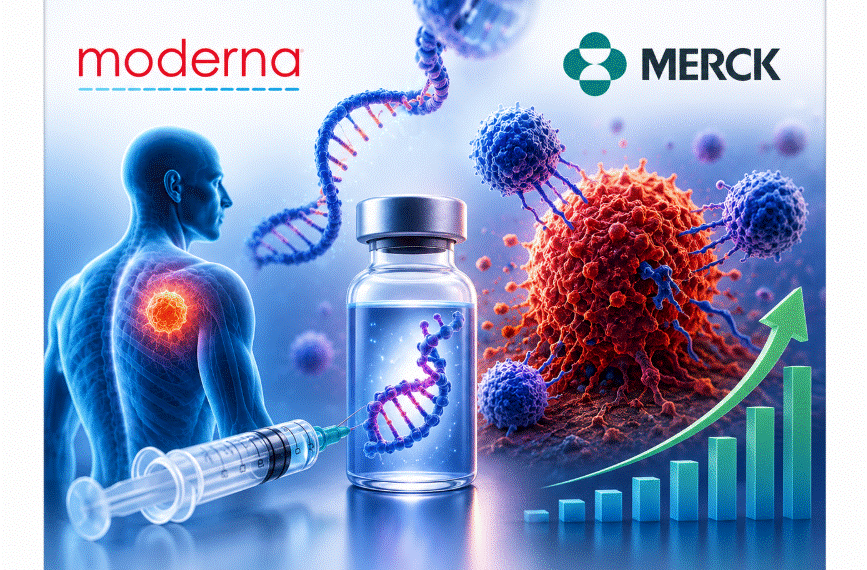
Merck & Co. (known as MSD outside the US) is set to report its full-year 2025 earnings in late January 2026, ahead of market opening, followed by investor discussions that are expected to focus on one overriding strategic question:
How convincingly can Merck extend growth beyond Keytruda as its oncology cornerstone approaches the second half of the decade?
While Merck remains one of global pharma’s most profitable innovators, 2026 marks a transition phase—from peak execution to long-term reinvention.
Why This Earnings Release Matters More Than the Numbers
Merck enters 2026 from a position of strength, but also strategic vulnerability.
- Keytruda continues to be the world’s top-selling cancer drug
- Oncology remains Merck’s growth engine
- Yet investors increasingly view Merck through a post-Keytruda lens, with patent expiry looming later in the decade
This earnings cycle will test whether Merck’s pipeline breadth, BD strategy, and capital deployment can meaningfully offset future concentration risk.
Portfolio Performance: Keytruda Still Dominates—But the Market Wants the “Next Pillar”
Merck’s 2025 performance is expected to again highlight exceptional oncology execution, led by continued global expansion of Keytruda across tumor types and earlier-line settings.
Key areas of focus:
- Durability of Keytruda growth across competitive oncology markets
- Performance of vaccines, particularly HPV and pneumococcal franchises
- Contribution from newer oncology and specialty assets beyond PD-1
While revenue momentum remains strong, investor attention is shifting from how much Keytruda grew to how much else grew alongside it.
Oncology Pipeline: The Race to Build a Multi-Asset Future
Merck’s oncology pipeline will be the centerpiece of its 2026 narrative.
Expected discussion areas include:
Next-Generation Oncology Platforms
- Antibody-drug conjugates (ADCs) targeting solid tumors
- Novel immuno-oncology combinations designed to extend or complement PD-1 therapy
Earlier-Stage and Precision Oncology
- Assets focused on biomarker-driven populations
- Strategies to compete in crowded tumor indications with differentiated mechanisms
Life After PD-1
- Clear timelines for late-stage assets capable of becoming meaningful revenue contributors before Keytruda’s decline
The market will be listening closely for specific milestones, not just platform ambition.
Business Development & M&A: Execution Over Optionality
Merck has been active in business development, but investors now expect scale and speed.
Key questions include:
- Will Merck pursue large, transformative oncology deals—or continue bolt-on innovation?
- How aggressively will capital be deployed to secure late-stage assets?
- Can Merck integrate external innovation fast enough to matter before 2028–2030?
In a market where peers are making bold bets, incrementalism may no longer be enough.
Competitive Landscape: Oncology Is Getting More Crowded
Merck’s dominance in immuno-oncology is increasingly challenged by:
- ADC-focused strategies from Roche, AstraZeneca, and Chinese innovators
- Combination regimens that reduce reliance on single-agent PD-1 therapy
- Rapid innovation cycles driven by AI-enabled target discovery and trial design
Maintaining leadership now requires continuous reinvention, not legacy advantage.
2026 Guidance: Confidence, Caution—or Strategic Reset?
Merck’s 2026 outlook will be dissected for signals on:
- Revenue expectations tied to oncology diversification
- R&D investment levels versus shareholder returns
- Willingness to accept near-term margin pressure to secure long-term growth
Any adjustment in tone—optimistic or conservative—will be read as a signal of management conviction.
Strategic Insight
Key takeaway: Merck’s late-January 2026 earnings are not about celebrating another strong year of Keytruda-led growth—they are about proving that Merck can remain a growth company after its most successful drug ever begins to fade.
For investors and industry observers alike, the core question remains:
Can Merck build its next oncology era before the current one peaks—or will the post-Keytruda transition define the company’s next decade?

 By
By